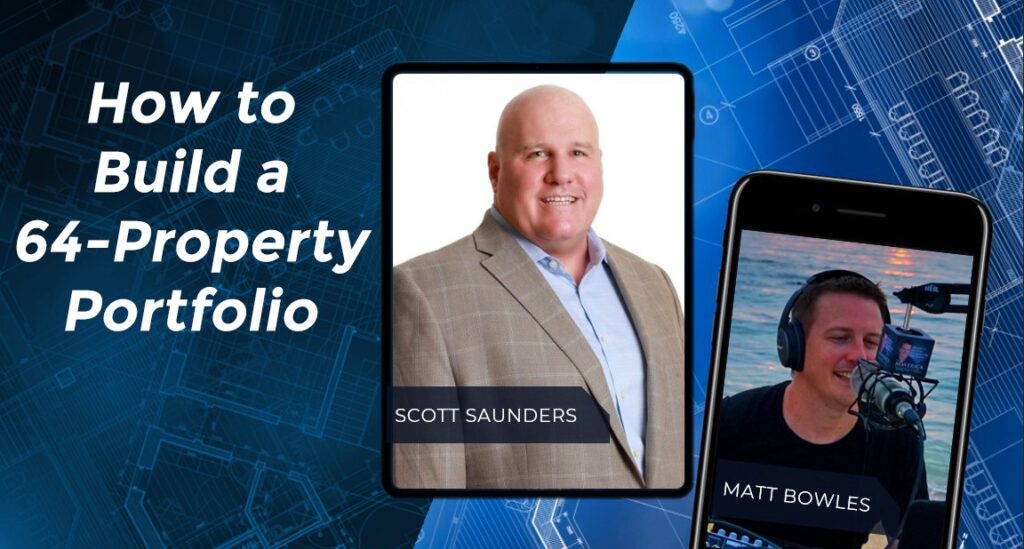
Matt Bowles: My guest today is Scott Saunders. He’s a long-time real estate investor and client of my company Maverick Investor Group. He has built a portfolio of 82 turnkey rental properties. He’s also a 1031 Exchange Expert and Tax Strategist who has been involved in over 100,000 transactions during his 37 in the exchange industry. Today he helps real estate investors achieve financial freedom in 10 years or less by understanding the tax code, acquiring turnkey real estate and using a uniquely designed vault to save cash, which can also be used as a line of credit. He has been featured in the Wall Street Journal, Forbes, CNBC, US News and World Report and many other places that you would know.
Scott, welcome to the show.
Scott Saunders: Matt great to be with you. I always love visiting with you and look forward to having a chat and discussion. Great to be with you again today. And yeah, I am a client so I get to talk. And I’ve actually purchased, I think three assets from Maverick, a couple up in St. Louis and one down in Memphis, Tennessee. So, it’s great to visit with you once again.
Matt Bowles: Great to have you here, Scott well, let’s just start off talking about your background. I want to give some context on the Scott Saunders story. Can you share a little bit where you’re from, where you grew up and then talk about your decision to buy your very first rental property?
Scott Saunders: Yeah, happy to do that. I grew up out in California and then I moved to Colorado back in 1997. So, I’m a, I’m an outdoor lover. I love hiking, fishing, being outside in the winter, I’m skiing. So, a place like Colorado, where you got the mountains is just a perfect place for me. So that’s kind of what I did. My background is Business Economics. That’s what I studied in school. And I went from graduating there and I got right into the 1031 Exchange Industry way back before they even had treasury regulations providing guidance. So, it was back in 88 when things were, it was cowboy country back then. And I kind of got involved with 1031 exchanges and that allowed me to touch a lot of investment transactions and just get a feel for what do people do, where do they invest their capital. And that was kind of my gateway into the world of real estate investing.
Years ago, I bought my first investment was a fourplex here in Colorado Springs and I bought it and I will tell you, I did everything what I consider wrong now. I bought it and I went in and I tried to take a C plus asset. I over improved it. I tried putting in nice fencing and landscaping. I paid the parking lot. I tried to make it look better. I managed it myself. And bad, I am not good. I’m not a handy person at all. I mean, I could put paint on walls, but I can barely change a plumbing fixture. And so here I was trying to manage tenants with four units. I had to go down to where it was located, which is about 40 minutes south of me, right? So, I’m driving back and forth on weekends and evenings and I was like, wow I knew real estate was a way to build wealth. I had that and I got that down. But boy, I did not do it. It was not a good fit for me managing it. I love having turnkey real estate that is not in my marketplace where I have professionals that are good at it, that love it. I’m the first guy to go. I am happy to pay a PM fee.
In fact, it’s the best money I spend is to let a pro in the market take care of that, maintain it. I’m not personally cut out for that. And to me, that opens up real estate investing for the people that are watching this. You don’t have to be hands on. You don’t necessarily have to be in your marketplace, you know, picking it up and rolling the paint and screening the tenants and doing all that. The turnkey model, where you buy with providers that are in really good markets and they’ve got good relationships. Once you get your head around that, it is the way to go. And technology, you know this. I mean, you’re a techno genius of being able to be remote and operate your life. But technology makes it so easy today. You can see your property by zooming in on, you know, Google Earth or Zillow. You can see the street. I mean, it’s really easy with technology to take a turnkey model and incorporate that and use it to build wealth.
Matt Bowles: Well, Scott, I’m curious about the journey from how you got to that very first rental property and the challenges that you had with it. How then did you decide you did in fact want to buy more rental properties? You didn’t just say, this is too much work, it’s not profitable. Real estate isn’t for me. You decided to buy another rental property and then eventually to scale up your portfolio all the way to 82 units today. Can you share a little bit about that journey from that first property and the challenges you had? Why did you continue with real estate? What was the second property like, and how did it go from there?
Scott Saunders: Well, I’ll tell you from the first one, I actually don’t have that property anymore. I lost it in a divorce. So, the one that the beauty of a divorce is you take everything you have and half goes to one party and half to the other. So, I actually, that asset went away in a divorce. And I think in a way that’s really what kind of drove me back towards real estate investing is you go through a financial shock, you go through divorce, and you lose a lot of what you built up and you’re like, okay, I got to go build everything all up all over again. And I really liked running into and discovering that turnkey model of real estate of just buying kind of ordinary single-family homes. I’m exposed to everything that’s out there. I’ve got lots of friends on the commercial side and apartments and all sorts of commercial building. But I really like the model of single-family homes. You need it, they appreciate well. You can lock in long term financing debt for 30 years at a fixed rate. That is a financial windfall for people.
So sometimes, you know, people look at multifamily or self-storage or all these different asset classes that are talked about and they overlook what I think is probably one of the easier forms, which is just buying little single-family homes in really good markets that you rent. So, buying the right asset in the right market and then getting the right property manager, that’s a winning for formula. And what I love about it, Matt, it’s accessible to everybody. You know, there’s so many people in America that are struggling, they’re fighting inflation. A lot of people over time can save up a down payment and you can pick up a home. Let’s just pick up, put a number, let’s say $150,000 home in Memphis or some of the markets that you’re in, like Wichita or St. Louis. So, 150,000, if you just do a 20% down payment, you need 30,000 and another, let’s call it $4,000 for closing costs or so. So, $34,000, $34,000. You can get a rental real estate that’s accessible. People can save up that amount of money. If you’re in, you know, California, Los Angeles, a home cost a million bucks. Same thing in Boston, New York.
It’s really tough to get in and actually buy homes in a lot of markets where people live. But these Midwest markets that I know you’ve got access to through Maverick, there are a lot of really attractive markets that provide fairly predictable income that appreciate on a steady basis. They don’t necessarily zoom up, but they have good, slow, steady appreciation that keeps up with inflation. So, I got back into the game and decided I wanted to start buying single family homes. And I just decided to pick up one and then pick up another and then another. I will tell you, for me, part of that journey was getting plugged into a community of like-minded investors. So, it’s really hard to do anything well, kind of being a solo and doing it on your own. But now when you’re in a group of people that are doing the same thing and you’re all moving towards financial freedom together, you now have this community where you can encourage one another and you can start sharing resources, names of home inspectors or what about this market or what about this lender?
For me, that was a big piece of it. I got involved with a group that I’m still involved with today and we have a whole community of like-minded investors that are all moving towards one simple thing, financial freedom, right? Having the time back to be able to live. We’re not moving towards, you know, picking up the ego home or the ego cars or that, you know, and maybe people pick those up along the way. The goal is really simple. It’s financial freedom. Having enough passive income coming in to cover living expenses and then build that up in a really stable manner where that continues to grow and compound over time. And so being in a community of like-minded people, that for me was really a big part of my journey, was just hanging out with other people all on the same path, some a little farther ahead of me, some right where I was at.
And now today, you know, I’ve been doing that in that group now for six years or so. And so now I’m able to kind of reach back and help other people, you know, buy their first asset. I’ve kind of cut my teeth and made my mistakes and learned some different things. And so, it’s fun being able to share things that I’ve learned and help people shortcut the process because, you know, you’ve been at this mat for a while and boy, when you go out and you get some reps and you buy different assets, you learn some things, you do some things right, you do some things wrong. And you know, we all got a few battle wounds, I think.
Matt Bowles: Absolutely. Well, I want to ask you a little bit about the tactics of scaling a portfolio. So instead of people thinking about, I want to get wealth one or maybe two rental properties, if they’re coming into the real estate investing space. And they’re thinking all of a sudden, portfolio wise, that they want to have a goal of getting 10, 20 type rental properties. For some people, that sounds far-fetched. It sounds they wouldn’t even know how to approach a strategy to build a 20-property portfolio. You’ve built an 82-property portfolio. Can you break down some of the tactics and some of the ways that people should think about a portfolio building strategy to acquire that many rental properties?
Scott Saunders: Yes. I think first off, it’s going to start in your head. What’s your why, why are you doing this right? You got to have something powerful that’s drawing you. Number two, you want to sit down and you want to get a game plan in place. You want to have a process laid out to do that that’s manageable and that you can begin to scale. And everything really starts, Matt, with the first purchase. It’s saving up the capital and making that first acquisition and doing the best you can. I would say a key is realizing when you’re building a portfolio, nobody’s going to bat a thousand. You can’t go out there and buy 10 or 20 assets. You’re going to end up in and have them all be great performers in the best markets with great appreciation. You’re going to have some that are hits, you’re going to have some that are so. And you’re going to have one or two outliers that are a little frustrating. It’s like anything else in life as you get some repetitions, right, some work out well and one or two don’t perform.
So, to do that, you want to start out by design, take action is probably one of the keys you want to move into it. You don’t want to be reading 10, 20, 30 books and listening to all the podcasts. You want to set a goal. I did it through something called 90-day targets. It’s a three-month target. So, I put all my focus on one goal, knocking that out. And then when I hit that target, I then set another 90-day target. And in one year you’ve got four different 90-day targets. So, let’s just say it’s buying four homes. You don’t worry about buying four, you just worry about buying the first one, then you worry about saving the capital by the next. And so, for me, breaking it into smaller bite sized chunks was really critical. I mean, how many of us sit there in December, January of a year and we’ve got big, lofty annual goals that are wonderful, but they’re so hard to Achieve because there’s such a big gap to get there. I think sometimes breaking it into a little small gap, one asset and one market. So, take my example, focus on saving up to buy the first asset for 150,000 and make that.
The other thing that helps is looking at all your resources. So maybe it’s redirecting money. You’ve maybe even saving up in a 401k or a qualified plan. Stopping that and saying, look, I’m going to go into real estate because I know 90% of the millionaires in America made their wealth through investment real estate. So, stop doing some things, redirect capital into real estate. So that would be one piece is a 90-day targets, the other one and when you build a portfolio is you want to be a little strategic about it. You don’t necessarily want to be deep with all of those assets in one market you want to pick up some diversification. So, in a portfolio of 10 to 20 assets, you probably want to be in maybe three or four markets. And there’s a big benefit from that, which is you don’t know which market long term is going to outperform.
I’ll give you an example. I’ve been in Memphis for a few years. Memphis recently just got a $10 billion Google investment coming in. When I bought Google was not a part of the marketplace. It was more of FedEx and that it was a lot of industrial warehouses. Elon Musk building a supercomputer there in the Mississippi River. And AI is now coming in. Who would have ever thought of Memphis, Tennessee having kind of a tech AI component? But it’s beginning to pick up some momentum. But that was just being diversified. So, I think one piece is you’re going to build a portfolio, look at several different markets. And then maybe another piece of that too is you know, there’s always that debate in real estate of cash flow versus appreciation, right? And you’ll hear people talk about that and sometimes people are kind of sold. You know, you want to get cash flow. It’s going to take a lot of, a lot of homes to get enough cash flow to offset your monthly living expenses. The analysis that I’ve done shows that over a 10-year period, 88% of wealth comes on appreciation. About 12% comes on the cash flow over that asset.
So, you need a balance of appreciation and cash flow. I would say as you’re building a portfolio, you want to have some that maybe are a little stronger in cash flow, but you also want to make sure you’ve got markets with Good long-term appreciation, that’s key. And I’ll add one more comment. I’m sorry, I’m talking a lot here, Matt. I’ll let you get a word in. The other one too is, you know, a friend of mine that I preach this, which is always buy with some positive cash flow, right? It may be, it’s not a lot, but you want to buy and make sure your property pencils out and you’ve got some cash flow. Six years ago, it was 2, $300 a month cash flow. Today it might be 30, 40, 50, 80. But cash flow allows you to keep in the game of real estate investing. You’re going to weather some challenges and having the positive cash flow, you know, that’s where people get into trouble, is where they’re upside down and things don’t go well economically. And now they’re behind the eight ball and then all of a sudden, they start having to face selling off their portfolio or losing their investments.
So, buying for a little positive cash flow. In a lot of these Midwest markets, you can get positive cash flow by putting down a 25% down payment. You can get something that pencils out and it may not be a lot, it might be 80 bucks or a hundred, but that’s a piece of the process there for sure.
Matt Bowles: Well, Scott, you have now been investing in real estate for over 20 years. You’ve built up this 82-property portfolio and you’ve already alluded to the first fact that you have made a lot of different mistakes along the way. So, as you think back on your 20 plus year real estate investing journey, the things that went right, the things that went wrong, I want to ask you for the top three lessons. If you were to distill it down, the top three lessons that you’ve learned along the way, that you wish you knew when you were starting out, if you could go back in time, do it all over again, the top three lessons you would give to yourself. Let’s start with lesson number one. What would that be?
Scott Saunders: Lesson number one is really simple and it’s what I do pretty well today. Learn how to master the game of taxes. You’ve got this tax code that’s out there and nobody likes paying taxes. But the tax code was designed with all these incentives built into it. And Matt, you know, real estate is a favorite asset class. The tax code has all these things in there that are really beneficial for owning and operating real estate for a simple reason. The government knows they need our help as investors to do this. They can’t provide high quality real estate all over the country. So, they provide all these incentives in the code to attract capital into real estate.
So, number one, look at the tax code and realize there are all these incentives built in and start looking about ways as to begin to use those and incorporate them in different things. So, you mentioned I’ve got a background in 1031 exchanges. That’s a powerful tool to allow somebody to expand their portfolio, re-deploy equity, and reinvest that capital without paying the taxes into better performing properties. But there are all sorts of other things available. You can begin to set up your real estate portfolio and run it as a real estate business. And that’s really critical. Now, when you do that, you unlock converting personal expenses and making them legitimate business expenses. So, things like your home Internet, your cell phone, if you set up things properly, and it’s more than we can talk about on a little podcast, there are ways to do that.
So, I would say look at the tax code as a treasure map and then start picking off those things and taking advantage of it. Here’s why this one’s so important, you make an extra amount of money, if you end up giving to Uncle Sam a big chunk of it, 30, 40% in taxes, you’ve got less to invest. If I now make that same amount of money, but I’m able to move how I earn it, you know, I pull some over and did this real estate business category and I’m able to save 10, 20, 30,000 in taxes, that gives me the fuel over here to have another down payment to pick up another asset. So, step number one, become a student of the tax code. The more you can do that. I did that late and now I’m a big advocate of really looking for every possible legitimate tax strategy. And to the extent you can incorporate it or work together with your spouse to incorporate it, do it. So that would be number one, right off the bat.
Matt Bowles: I think that is a great piece of advice, Scott. And one of the things that I will say if people are hearing this for the very first time is, is that when you go to hire a CPA or a tax strategist, you want to be sure that you are hiring a CPA that specializes in this particular niche, because not all CPAs know about this stuff. There’s a lot of CPAs that are primarily filing taxes for W2 employees, and that is what they do for their business. So, you want to find CPAs and tax strategies that specialize in real estate investment and business ownership. And that is the super majority of their business and their specialty. And when you do that, all of a sudden, as you said, Scott, that unlocks a whole world of opportunity. Well, I want to move on to lesson number two. What would that be?
Scott Saunders: So, lesson number two would be get involved in a community of real estate investors and people that are seeking the same thing you are. You become like the people you associate with. And let’s be honest, not everybody on your street wants to become a successful real estate investor. And an even really smaller segment wants to become financially free. You know, when you think of that North Star of financial freedom, very few people really have that. A lot of people are just kind of going through the motions, doing the same old thing, working a job and they’re going to kick the can and hope somewhere in retirement down the road they can live their dream life.
So, step, you know, principle number two, go into a community of people that have a big goal and a big vision. Get involved with other real estate investors and people that are like minded, that are growing, they’re reading books, they’re listening to podcasts. And what’s neat about those communities is you have people like you and I who that love sharing things. We love nothing more than helping people out avoid some of the mistakes. So, get involved in a community. The group that I’m with is called Money Mastery and that’s all we do is we focus on financial freedom in 10 years or less. That’s our North Star how to do that and in that we meet together over the Internet on zoom calls, we have conversations and you can find a group of investors. There are local real estate associations, you can connect on ones online but surround yourself with people that are all moving the same direction because life is like that, it’s coming at us. And so many people react to life and they’re just trying to keep on the treadmill. It’s a really small group of people that are thinking strategically towards the future.
So, find those people, find your tribe, hang out with them, make them your friends, make them your mentors and spend a lot of time and the better you’re off at doing that. I will tell you; I learned this one way too late in life. I’ll be this weekend with some of the biggest names in real estate. And these people, I can say now I’ve become friends with them because I’m hanging out with them. And these are people that have, you know, portfolios that make mine look like nothing. But it’s great that I get to interact with them and I learn how they think. I learn their mindset, and then I also learn through their relationships. There’s a great value in that. So, I would say number two, make that a top priority. If you want to get ahead in investing, you got to find your community and you got to invest in that and make that a big priority.
Matt Bowles: Great advice. Totally agree with that one. All right, Scott, what would lesson number three be?
Scott Saunders: All right, so here’s lesson number three. And this one’s going to be a little different, which is I want to share with your kind of a different way of looking, of where you store your capital. So, a lot of people go to a bank, get excess money, and I walk out into a bank and I keep it there. There is a whole concept out there, and we call it creating a vault, but a place to store your money where it’s safe, where it grows, and where you can have access to it as a private line of credit. And that’s, it’s something that’s been around for hundreds of years. It’s an overfunded, high cash value whole life insurance policy. And what’s unique about this, Matt, when most people think of life insurance, they think of, I want to get the maximum death benefit and pay the lowest premium. This is exactly the opposite. So, this is a place to warehouse cash, to store cash. So, it’s for the maximum cash value with the minimum amount of death benefit. So, it’s a unique place.
And this is something that I’ve learned over time that a lot of very wealthy individuals have these types of whole life insurance policies. Joe Biden, on his tax return, had five of these years ago, Walt Disney, when he wanted to start Disney, he borrowed against his whole life insurance policy and started Disney. John McCain, when he ran for president, borrowed $3 million from his own life insurance policy to run for president. And so, there’s story after story. This is a way whereas real estate investors, you can have $1 working in two places. So, we love leverage in real estate. I put $1 in this policy. I can borrow against that for a down payment. It stays in that policy still growing in value, and then I use that for the down payment. Then I go on ahead and I get leverage from the bank. So, it’s now a tool to be able to get our money working for us more effectively than before. It doesn’t really do much going into a local bank, but creating what I call it’s the ownership economy, creating your own source of capital. Where now I’ve got access to this.
Anytime I wanted to purchase another property, I’ve got it. And then what I do is I take the rental income from my real estate portfolio, I run it back into the policy, and I build up the cash value again. So, it becomes a financial tool to help me move towards financial freedom. It’s a tool that I use. So real estate is a way to build wealth. This vault, this high cash value, overfunded life insurance policy is another tool that I can use to accelerate building wealth. And now it becomes an ecosystem. Putting money into the policy, pulling it out for a down payment, taking the cash flow, and then building up the cash value again. Now I’ve got two different levers I can use. I’ve got my real estate portfolio growing that I can refinance and extract equity out without paying taxes. I’ve got this cash value in a policy that I can borrow against tax free and use it for whatever I want. So, I’ve got two powerful levers.
And so long term, Matt, what the challenge is, is how do we convert all that equity into income? And by using cash out refinances along with a policy, these two mechanisms working together provide a really powerful tool for people to begin to have income that they can get off of their equity. And at the end of the day, what do we look with all investing? What is it about? It’s about having income to live the life that we want. So that’s the challenge is how do we get the income off of it? I don’t care whether you’re investing in stocks and bonds or real estate. The traditional way with Wall Street is that 4% drawdown, right? I build a pile of money and then I hopefully draw it down. And hopefully I don’t outlive it. And hopefully inflation doesn’t whack me too much that I can live with real estate. I’ve got an asset that goes up in value with inflation that I use positive leverage, right? And then I’m also now combining that with this policy, what we call a Vault. Those two concepts are going up in value. The dividends make the value higher. My real estate gets higher. So now I’ve created an ecosystem that’s growing and I just harvest the equity out of those two things. So, it absolutely demolishes the Wall Street model. It’s so much more effective combining those two strategies.
So, you asked for tip number three. Tip number three would be run your savings through this uniquely designed strategy and then use that to go out and buy real estate. The, the numbers on this are phenomenal. You’ll get almost double the returns by combining those two concepts together. And this is how an average investor can become financially free is by using these strategies, right? Being in a like-minded community, tax strategy, and then using this uniquely designed vault. This gives the average investor the tools to really achieve financial freedom. And that’s what we all are not we all want, but many of us probably listening to your podcast want to be financially free. That’s, that’s the big objective for so many of us.
Matt Bowles: Scott, if people are interested in learning more about this, hearing more from you, can you share a little bit about some of the ways that you’re working with real estate investors these days and some of the content that you’re producing and how people can come into your world, connect with you and learn more?
Scott Saunders: Yeah, happy to share that. First of all, I’ve got a link for people. People can learn a whole lot more about this. It’s retirein10years.com/matt. And here’s what they can do, at that link they can get a free book which was written by Brian D. Lee and Robert Allen. And the title of the book’s really simple, how to Retire in 10 Years or Less. So that’s the title. The book’s going to lay out exactly how to do that step by step. And here’s the benefit. There’s a whole companion course at that link that people can get into and they can start seeing videos and information. They can get access to calculators and tools to actually begin understanding these principles. So, I’m involved in that community. It’s called Money Mastery. My email is just coachscott@wealthoutsidewallstreet.com. So, anybody can email me at any time. I’m more than happy to talk about this material. But the link that I gave first, that’s the best way to kind of get access to the strategies on how to do this. It’s a fun journey. I know you’re traveling around the world, Matt. I mean, that was where I started off. Today I’m like, where are you? Where are you going next? And I tell you, you inspire me because you’re actually living the lifestyle off of your real estate income and going around the world and living it today. And man, if we could boil it all down, life is not about someday I’ll do this. It’s about stepping into financial freedom today, living today with the health that you’ve got today, making the most of each day now in the present. Because our time ultimately is really our most valuable asset. So much more so than any real estate portfolio. And stepping into taking advantage of the time and the moments that we have right now, that’s really the big deal. And that’s what our whole community teaches is how to value our most precious asset, which is time. So that’s what we’re about.
Matt Bowles: Scott, I think that’s the perfect place to close out this interview. We are going to link up everything we’ve discussed in the show notes so you can find the link to get those free offers from Scott as well as to contact him directly as email. All of that is going to be in the show notes. Scott thank you so much for coming on the show my friend. This was great.
Scott Saunders: Hi awesome as always Matt. Great to visit with you.
DISCLAIMER: Just a reminder that nothing on this show should be considered specific financial, tax or investment advice. Please consult an appropriate tax, legal, real estate or financial professional for individualized advice. Opinions of the host and the guest are their own. All investment strategies carry risk and have the potential for profit or loss. Always conduct your own due diligence and consult with appropriate advisors before buying any real estate.